
Back to Nature for Experiential
Maybe the most powerful experience design is the kind that requires no design at all.

A confession to begin with:
I’m not a nature guy.
I live in Boulder, Colorado — a city where people own seven kinds of jackets for seven kinds of weather and casually mention “doing a fourteener before lunch” the way other people mention picking up dry cleaning. I have lived here for years. I have hiked maybe five times. I have gone camping exactly once; I didn’t need a second time to know that nature and I are frenemies. I am, by any honest definition, the wrong person to write this essay.
But over the last few months, I have kept reading the same data point in different forms. Funflation is squeezing households. Restaurant covers are down. Discretionary spending on going out is tightening across nearly every income bracket. And the thing people are quietly doing instead — without anyone briefing it, without anyone activating it, without anyone selling a ticket — is going to the park.
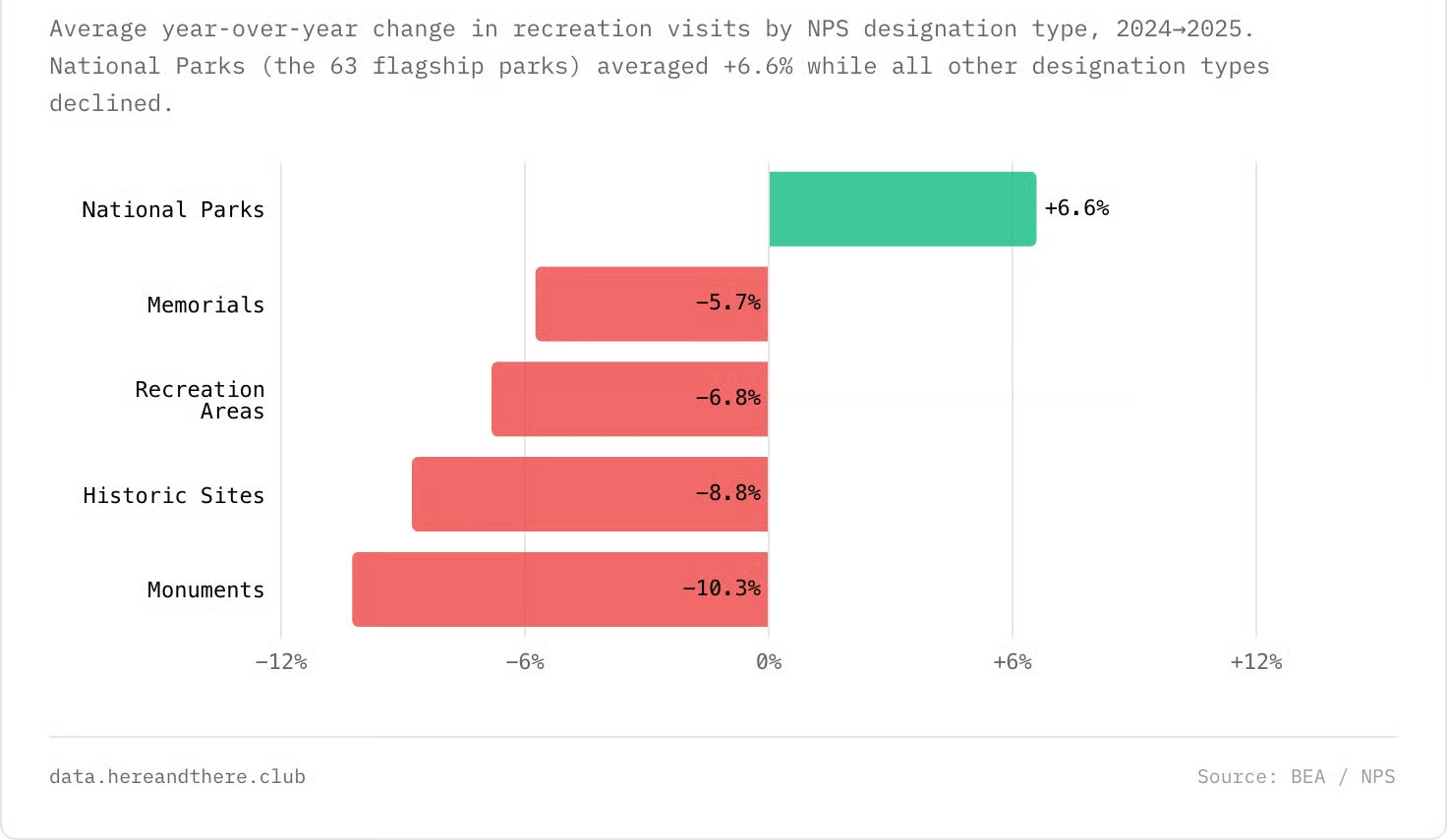
A new report from the Outdoor Industry Association, released this June, found that 183.2 million Americans participated in outdoor recreation in 2025 — a record, and roughly 30 million more participants than in 2019. The National Park Service logged 323 million recreation visits in the same year. The dip from 2024’s all-time high was attributed in large part to a 43-day federal shutdown; twenty-six individual parks still set records.
Older Americans are participating at rates that have climbed from one in four to more than four in ten over the past decade. Hispanic participation grew 6.5% last year. Two-thirds of households with children now participate.
When I read numbers like these, I think the same thing: the experiential industry is missing something enormous, and it has been missing it for a long time.
We rent warehouses. We build immersive enclosures. We construct branded environments inside which we attempt to manufacture — at considerable expense and with considerable effort — the kind of unscripted feeling that nature produces every day for free. We hire production designers to simulate forests. We pipe in birdsong. We commission “wellness zones” inside trade show floors. We spend six-figure budgets making people feel something a fifteen-minute walk in Chautauqua Park would have given them for the cost of leaving the house.
We are, in the most literal sense, building bad copies of the original. And we continue to miss the market and audience demand that it creates.
The Trillion Dollar Blue Sky
The global wellness tourism market was valued at $990.4 billion in 2025 and is projected to reach $2.4 trillion by 2035. The global nature-based tourism market sits at $476.9 billion in 2026. The number of spas worldwide grew from roughly 175,000 in 2019 to more than 200,000 in 2024.
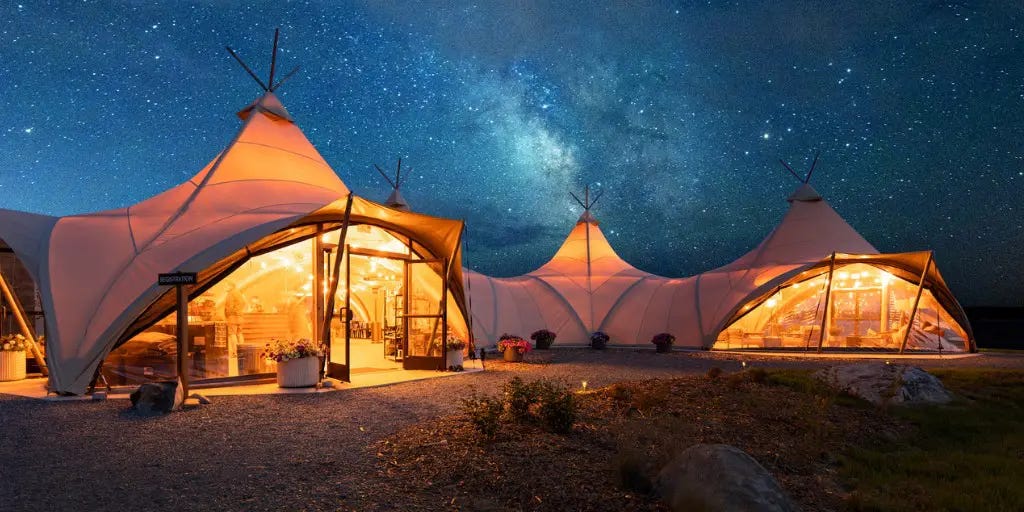
The glamping market, the smallest of the three, is the fastest growing, expanding at more than 10% a year. In a single twelve-month stretch in 2024, all three major US hotel loyalty programs entered the glamping business. Hilton partnered with AutoCamp. Under Canvas is now in the World of Hyatt. Marriott acquired Postcard Cabins outright to create the Outdoor Collection. Glamping has arrived and so has the institutional money with it,
New investment is going into experiences like the Halo Sauna at the Four Seasons in Toronto, which combines infrared heat, dry-salt therapy, chromotherapy, aromatherapy, and guided meditation, packaged as a single multi-sensory treatment at a Forbes Five-Star spa. The Biome experience at Corinthia London‘s new wellness concept is a luxury offering that markets itself as nature- and science-driven indoor therapy. The Marriott Luxury Wellbeing Series across Ritz-Carlton and St. Regis properties throughout Asia-Pacific continues to add properties. The trend is not stopping.
It’s Only Natural
P.T. Barnum is the canonical patron saint of American spectacle — the impresario who built immersive enclosures before we had the language for them, who understood that an audience would pay good money to enter a constructed world. The history of experiential marketing, traced loosely, runs through Barnum. But that may be the wrong lineage for experientialists to presume.
Theodore Roosevelt set aside roughly 230 million acres of public land during his presidency. National parks. National forests. National monuments. He created the most ambitious experiential infrastructure project in American history, and he did so without selling a ticket, writing a brief, or measuring an impression. His work shows that perhaps the most powerful experience design is the kind that requires no design at all.
Present-day experiential activations – marketing in particular – feel over-designed rather than under-designed. Maybe because so many of them are created and produced primarily on screens or boardrooms. These activations feel like they want to announce themselves; they try to demand attention. So much experiential marketing wants something from the participant — engagement, a share, a data capture, a moment of dwell time the metrics team can defend in a Monday recap. The spaces we build are mostly extractive. We don’t go much deeper than that.
But if you will permit me an excursion into biomimicry, I think there may be a point to this essay.
In the 1990s, the Japanese rail system had a problem with its Shinkansen bullet trains. When the trains exited tunnels at high speed, they produced a sonic boom loud enough to violate noise regulations and rattle windows in adjacent neighborhoods. The engineer assigned to solve the problem, Eiji Nakatsu, happened to be a birder. He noticed that kingfishers dive from low-density air into high-density water with almost no splash. He studied the bird’s beak. He redesigned the front of the bullet train to match its geometry. The sonic boom went away. The train became faster and more energy-efficient as a secondary benefit.
This is biomimicry — the discipline of solving engineering problems by studying the design solutions evolution has already produced over the course of roughly four billion years of research and development. Engineers practice it constantly. Velcro from burdock burrs. Building cooling systems modeled on termite mounds. Adhesives engineered from gecko feet. Wind turbine blades shaped by the tubercles of humpback whale fins.
The question worth asking, and the question this industry has never seriously asked, is why experiential marketing does not do the same thing?
The Non-Spectacle Spectacle
Nature does not require attention. It’s very much content to be ignored as I have ignored it for most of my life. In fact, I think nature rewards us only when attention to it feels chosen rather than extracted. To design activations away from attention is something that the experiential industry has not seriously tried before.
A recent study published in Environment International surveyed 50,363 people across 58 countries and found that contact with nature was consistently associated with higher self-compassion, greater body appreciation and overall life satisfaction. The mechanisms researchers point to are “cognitive quiet” — nature’s ability to lower the noise floor of the mind — and “perceived restoration.” Both are the opposite of what a branded activation is designed to produce.
And here is the line from the same body of research that should stop the industry cold. Co-author Viren Swami of Anglia Ruskin University, on what cancels the effect entirely: “If you spend time on your phone in nature, the benefits are canceled out, or the same as spending time indoors.” The phone cancels nature. The entire activation economy runs on the phone. Every Instagrammable wall, every shareable moment, every photo-op spectacle we have built for the last fifteen years is, by this measure, systematically eliminating the very thing the activation was supposed to produce.
Nature is not programmed. It does not perform. There is no narrative arc, no climax, no call to action when out in the woods or beach or meadow. There is only the slow unfolding of a place that is doing nothing in particular, and that nothingness turns out to be exactly what people will travel hours and pay nothing to receive. We spend so much design intention in filling a space with content and context but I have yet to see non-content take hold in the industry.
Nature is the same for everyone and different for everyone. No two people walk away with the same Grand Canyon in their minds. The experience is generated by the visitor, not imposed by the host. This is the kind of end-state that our industry rarely designs for and yet is intentionally sought by artists and audiences alike.
What does a forest understand about pacing that we do not? What does a coastline know about transitions that our production designers have not figured out? What does a river do to a human nervous system that no scripted activation has ever quite managed?
The experiential industry’s research and development budget is overwhelmingly directed at the next LED wall, the next projection-mapping technique, the next way to make a warehouse feel like something it isn’t — rather than at the prior and more useful question of what nature is doing right that we are doing wrong.
The one thing artificial intelligence cannot generate, simulate, or compress is the specific quality of being outside in actual weather, around actual strangers, on actual ground that was here before you and will be here after you. The unautomatable is not “physical experience” in the abstract. It is the irreducible specificity of being somewhere real. And there is no realer place than a place we did not build.
Am I on to something? Should we do more biomimicry or am I just being preachy? Is there a model for immersivity staring us right in the face that is the opposite of what we’ve been selling so far?
Maybe a walk in the mountains would do me some good.
Great views here Max - there is undeniable wonder and awe in nature : all of it. Some big data sets too… It’s generally the urban-construct of experiences that may be the blocker - you have me thinking, good one…
Thank you for this, Max! Going to walk to work today.